
How Not to Get Scammed - FIFA 2026
FIFA World Cup 2026 Series · Part 3 of 3 PropTrust Group · RentTrust Intelligence

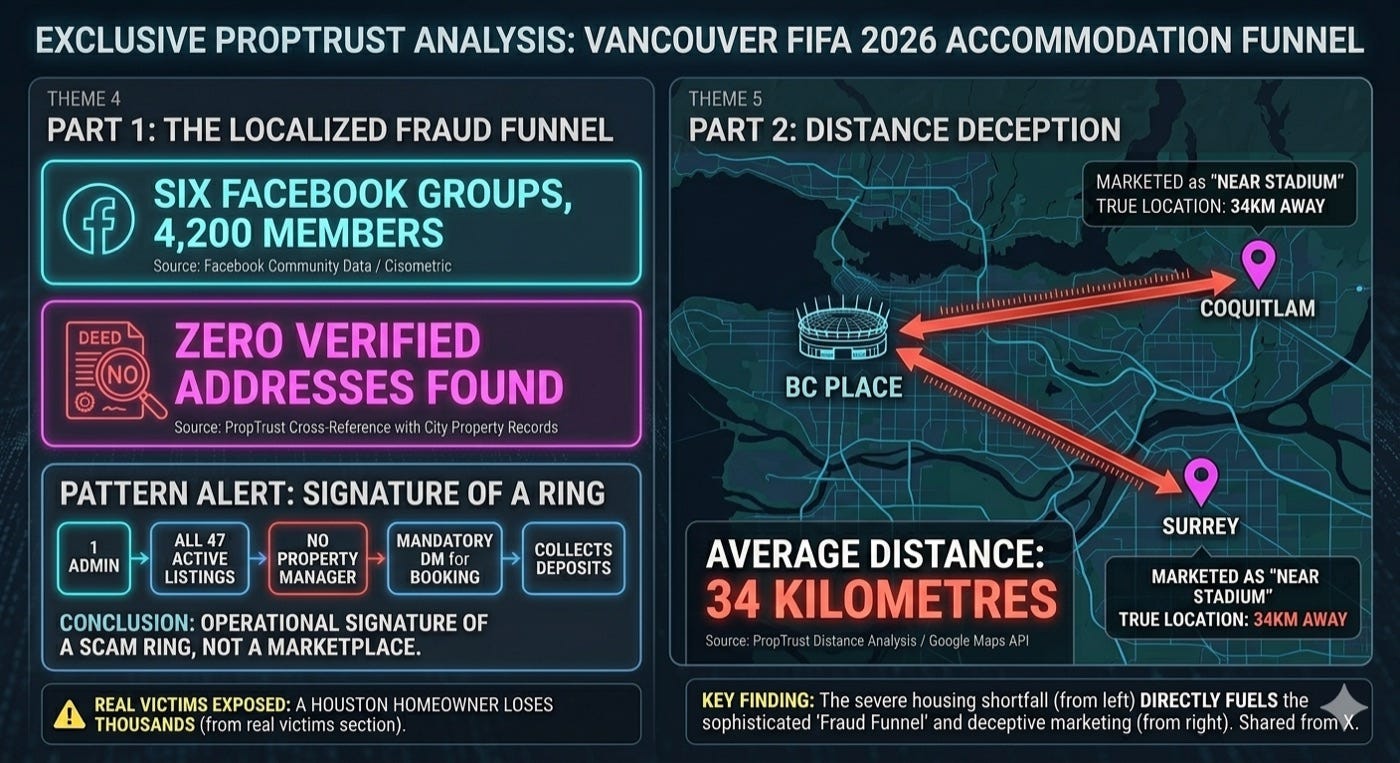
Parts 1 and 2 of this series documented the problem: a 70,000-room shortage, 4,300 fake domains, six Facebook scam groups with 4,200 members, and basement suites priced above the Fairmont. If you haven’t read them, the short version is this: the fraud infrastructure for FIFA 2026 is already built, already live, and already waiting for visitors who don’t know what to look for.
This part is the one you forward to someone who’s about to book.
What You’re Actually Risking
The useful question isn’t “is this listing real?” — it’s “what happens to my money and my accommodation if something goes wrong?”
Hotel: Chargeback rights. Physical address. Free cancellation on most rates. If the hotel closes, your credit card company recovers your money.
Licensed Airbnb / Vrbo: Payment held in escrow until check-in. Platform dispute resolution. Host identity verified. If the host cancels, the platform refunds and finds alternatives.
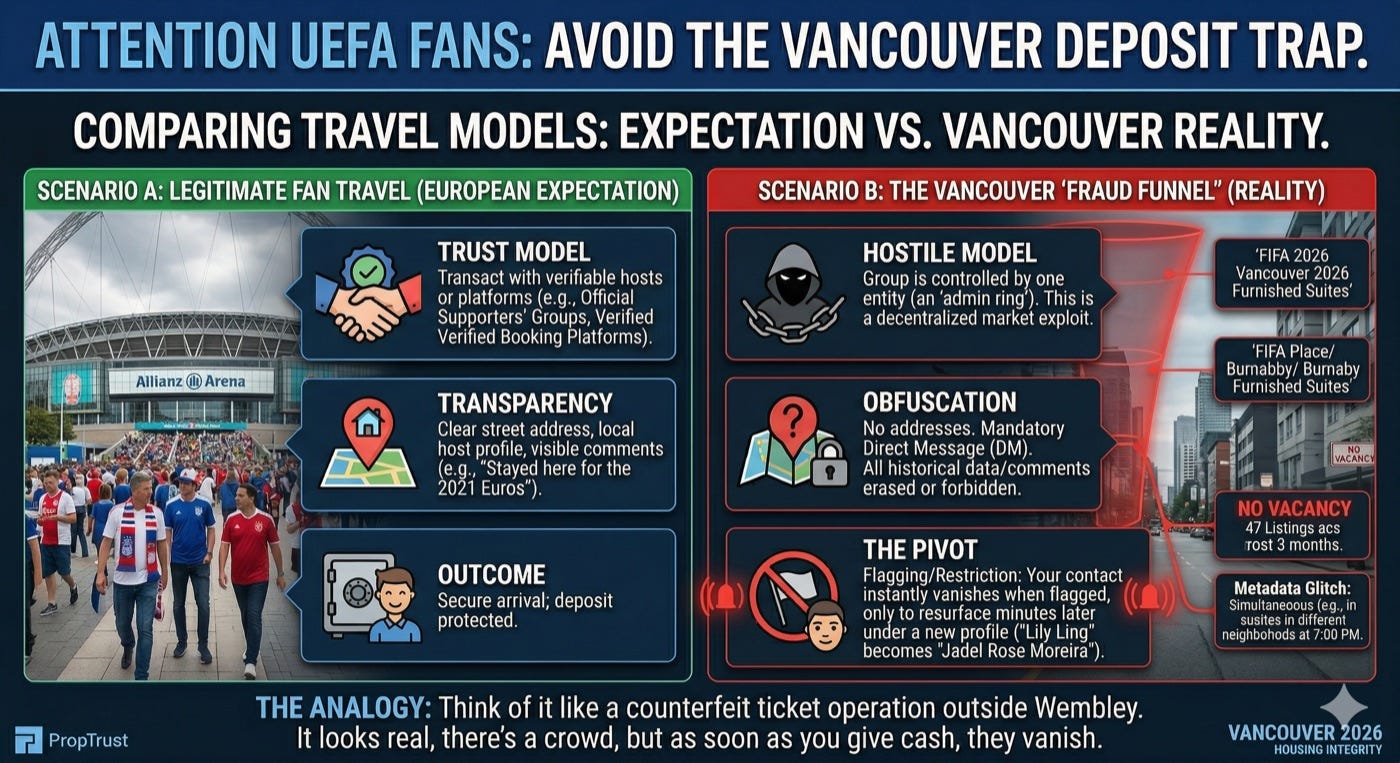
Unverified P2P rental (Facebook, Kijiji, private e-transfer): None of the above. You have a message thread and a payment that is already gone.
💰 THE PRICE REALITY — A budget hotel with full chargeback protection costs the same as an unverified basement suite with zero protection. You are not saving money by going informal. You are paying the same price for none of the safeguards.
The Five Scam Patterns
1. The Fake Portal
A website mimicking Airbnb, Vrbo, or official FIFA booking pages. Mobile-optimized, Google-indexed, built months in advance using the “domain aging” tactic. Collects full payment for accommodation that doesn’t exist.
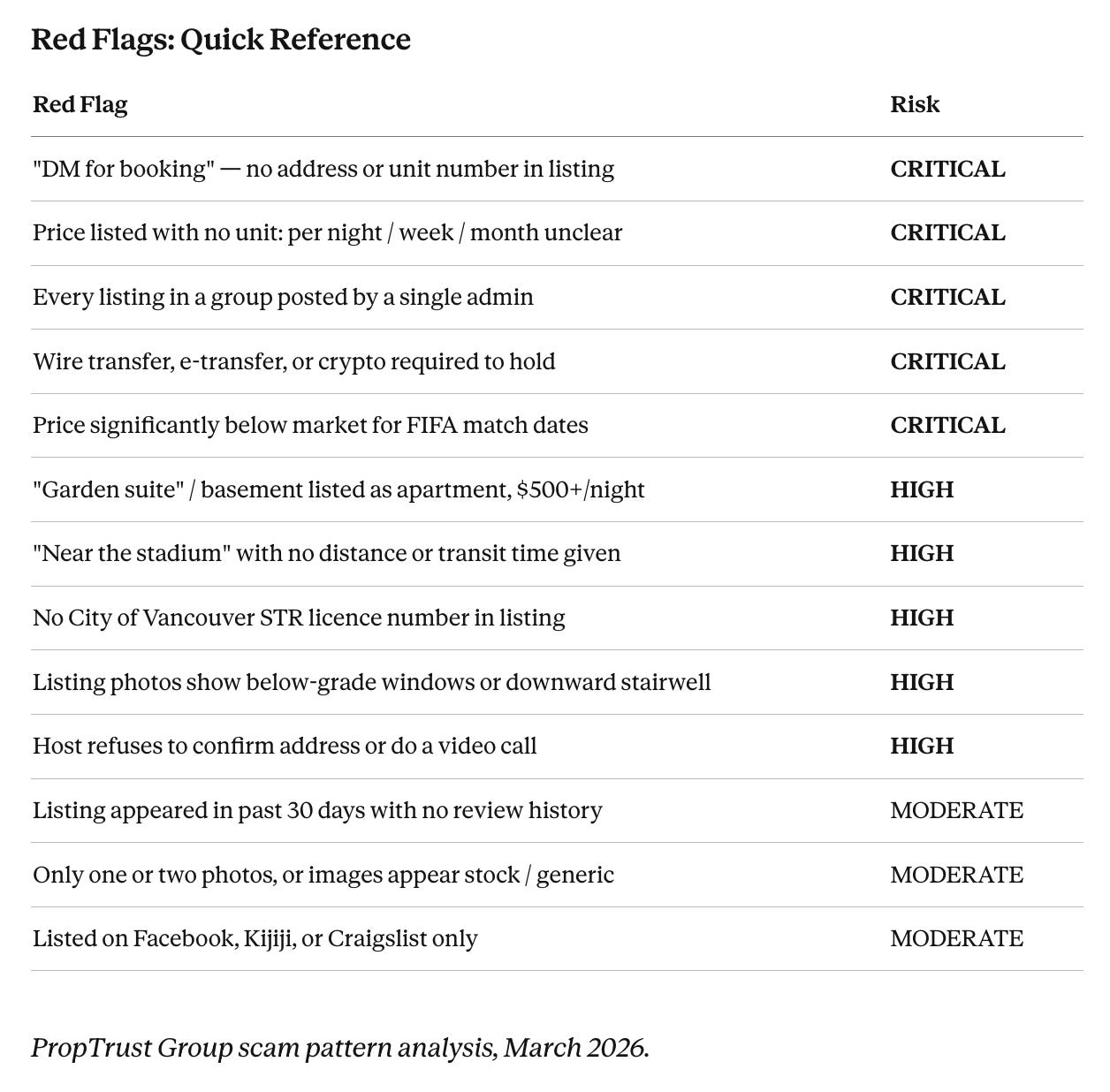
Spot it: URL is not airbnb.com, vrbo.com, or a verified FIFA channel. Payment goes through a form on the site rather than a recognized processor.
2. The Ghost Landlord
A real building used as cover. The person listing doesn’t own or control the unit. You arrive to find it occupied, access denied, or the “landlord” unreachable. Common variant: photos scraped from a legitimate listing on a different platform.
Spot it: Reverse image search the listing photos. If they appear elsewhere under a different name or price, the listing is fraudulent.
3. The Double-Book
One unit listed simultaneously on multiple platforms and “booked” by several parties. Multiple people pay deposits for the same accommodation. The scammer collects from all of them. Only one — or none — gets access on arrival.
Spot it: Search the address across Airbnb, Vrbo, Facebook, and Craigslist simultaneously. If the same unit appears at different prices across platforms, treat it as a double-list operation.
4. The Price-Test Listing
The same unit at three different prices across platforms — deliberately testing what each audience will pay. Prices are vague: “$600” with no unit (per night? per week? per month?). A visitor sees $600, assumes nightly, sends a deposit. The scammer clarifies terms — or disappears.
Spot it: Any listing that doesn’t explicitly state the pricing unit is being deliberately vague. Ask in writing before sending money. If they don’t answer clearly, walk away.
5. The Social Proof Group
A Facebook group with thousands of members creates the appearance of a legitimate marketplace. All listings posted by a single admin. Every booking requires a DM — nothing on record. The group exists to create credibility. The listings exist to collect deposits.
Spot it: Check who posts the listings. If one account runs all or most of them, it is a fraud funnel. PropTrust found one Vancouver group with 1,400 members where all 47 listings came from a single admin.
What PropTrust Checks — and What It Can’t
Our FIFA verification tool cross-references listings against Vancouver’s open municipal property data — unit level, every registered strata unit in the city.
Unit 1201 at 999 Seymour St — confirmed in city records. Strata lot verified, building management identified, tribunal history clear.
Unit 5000 at the same address — not found. The building has fewer than 5,000 units. Do not send a deposit.
🇨🇦 TORONTO NOTE — Toronto’s unit-level records (MPAC) are not publicly accessible. For Toronto listings, PropTrust runs building-level checks: does the building exist, does the unit count make sense, is there tribunal history. It catches the most common patterns — but it’s not unit-level verification. We’re transparent about that.
The tool is free. It takes less than a minute. Run it before you commit to anything.
The Short Version
Book through a licensed platform. Airbnb and Vrbo have escrow and dispute resolution. Facebook does not.
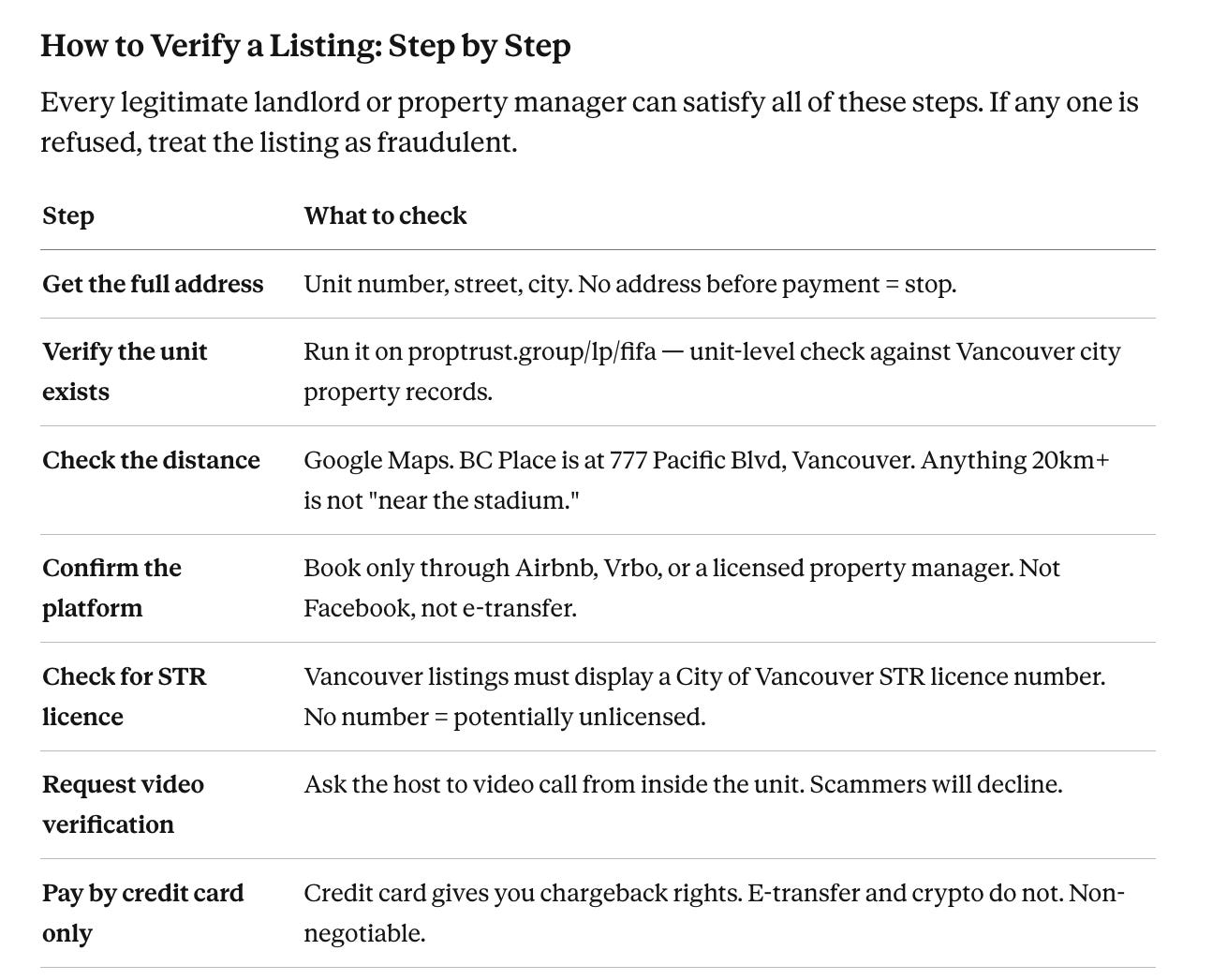
Get the full address and unit number before any money moves. If they won’t provide it, that’s your answer.
Run the address on PropTrust before you commit. Free, one minute, unit-level for Vancouver.
Pay by credit card only. Chargebacks exist for exactly this situation.
If it’s significantly cheaper than hotels for the same dates, it’s not a deal. It’s a signal.
If a “garden suite” is $700/night, the Fairmont Pacific Rim is $714. Book the Fairmont.
🔍 Free FIFA Rental Verification — PropTrust
Enter any Vancouver or Toronto address. We cross-check city property records, confirm the unit exists, show the building’s management profile and tribunal history, and tell you the actual distance from BC Place. Takes 60 seconds. Completely free.
PropTrust Group Inc. · renttrust.digital · proptrust.group For informational purposes only. Not legal or tenancy advice.